Recent Commentary:

Money, Banking, and Financial Markets
Currency market intervention accomplishes little on its own. Unless a change in monetary or fiscal policy follows, its effects fade within weeks. That is one reason the United States intervenes so rarely. Intervention is effective only when it signals a policy change to come.
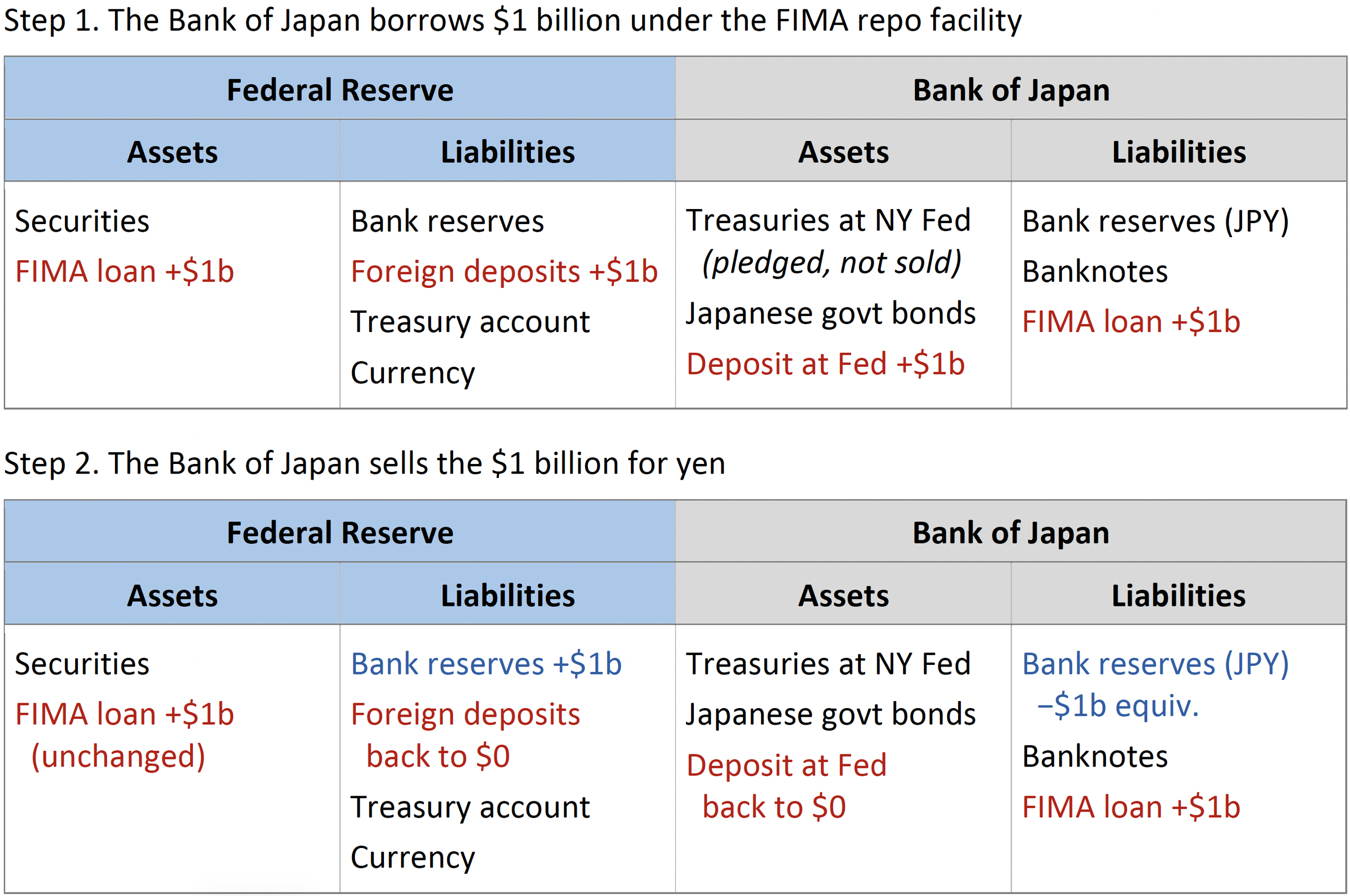
Even so, on July 31 the Treasury bought yen alongside Japan's Ministry of Finance. It was the first joint purchase of yen by the two governments since 1998. Two days later, Treasury Secretary Scott Bessent posted on X that the Fed should raise the $60 billion per-counterparty limit on its FIMA repo facility. He wrote that the limit should “be upsized in the coming months.” Shortly thereafter, Japanese authorities announced that they planned to draw on the facility to fund future intervention.
The request raises a serious question about central bank independence. Should the size of the Fed's balance sheet respond to a foreign government's exchange rate objective, at the request of the U.S. Treasury Secretary? We think it should not.
In this post, we describe how a FIMA loan works, explain its impact on the Fed’s balance sheet and compare it to alternative mechanisms for funding currency intervention. Our main message is that raising the cap hands short-term control of the Fed's balance sheet to a foreign government, and it would do so in the least visible way available.
We have written seven posts that address Chair Warsh's five task forces. This final post gathers the recommendations in a single place — 22 of them — and notes briefly how they fit together.
Our diagnoses share a common observation. In each of the five areas, the Committee steers by a number nobody observes: the inflation trend, the shock decomposition, the “stars”, the inflection point of reserve demand, and the reaction function itself. The Committee (or the public) infers these, typically using filters calibrated to a past distribution of shocks. Based on some combination of statistical filters and stylized models, these guides become fragile in key episodes, such as the broad pickup of prices in 2021.
The recommendations respond to this unobservables problem in five ways. In some, we ask the Fed to disclose what goes into the numbers it already produces. In others, we urge it to collect what it cannot currently see. In still others, we ask it to design policy that holds up when estimates prove wrong. In another, we urge it to keep checking that its routine estimation methods still work. And in two, we ask it not to discard what it currently produces before a credible replacement is available.