
The FIMA Cap and the Fed's Balance Sheet
“[FIMA] was not designed to stabilize Treasury borrowing rates by accommodating foreign authorities' exchange rate management operations, absent immediate financial stability threats.” Maurice Obstfeld, PIIE Realtime Economics, August 11, 2026.
“I am sure that, as a formal matter, what we are proposing to do is legal. But as I see it, this action—the whole package—is by any reasonable definition in substance a fiscal action, not a monetary policy action. […] I guess I just see it as a raid on our independence, and I regret it.” Alfred Broaddus, then President, Federal Reserve Bank of Richmond, FOMC Transcript, January 31–February 1, 1995, p. 141
Currency market intervention accomplishes little on its own. Unless a change in monetary or fiscal policy follows, its effects fade within weeks. That is one reason the United States intervenes so rarely. Intervention is effective only when it signals a policy change to come.
Even so, on July 31 the Treasury bought yen alongside Japan's Ministry of Finance. It was the first joint purchase of yen by the two governments since 1998. Two days later, Treasury Secretary Scott Bessent posted on X that the Fed should raise the $60 billion per-counterparty limit on its FIMA repo facility. He wrote that the limit should “be upsized in the coming months.” Shortly thereafter, Japanese authorities announced that they planned to draw on the facility to fund future intervention.
The request raises a serious question about central bank independence. Should the size of the Fed's balance sheet respond to a foreign government's exchange rate objective, at the request of the U.S. Treasury Secretary? We think it should not.
Chair Kevin Warsh took office in May, so this is an early test of the boundary between Treasury foreign exchange authority and Federal Reserve control of its balance sheet. The latter is a key element of monetary control and policy independence. Raising the FIMA cap would require approval of the FOMC's Foreign Currency Subcommittee, which includes only the Chair, the Vice Chair, and the President of the New York Fed. However, because the full Committee can take this delegated authority back, an FOMC majority must at least acquiesce.
In this post, we describe how a FIMA loan works, explain its impact on the Fed’s balance sheet and compare it to alternative mechanisms for funding currency intervention. Our main message is that raising the cap hands short-term control of the Fed's balance sheet to a foreign government, and it would do so in the least visible way available.
The mechanics
We start with the simple mechanics of currency intervention. Let’s take an example where authorities’ objectives is to support the yen and they choose to do it by selling dollars. The dollars sold are a liability of the Federal Reserve and the yen they purchase are a liability of the Bank of Japan. This adds dollar reserves to the U.S. banking system and drains yen reserves from the Japanese banking system.
Where can the Japanese authorities find the dollars they wish to sell? The most obvious answer is that the Japanese can sell some of the $1 trillion of official foreign exchange reserves, most of which is U.S. Treasury securities. Selling those securities in the open market would add to the supply that private investors must absorb. Yields would likely rise, and higher yields raise the cost of financing a large and rapidly growing federal debt. The Treasury wants to avoid that.
FIMA appears to offer an alternative. The Foreign and International Monetary Authorities repo facility lets a foreign central bank borrow dollars from the Fed. A repurchase agreement, or repo, is a collateralized loan. Eligible collateral is Treasury securities in custody at the New York Fed that total $2.6 trillion of such holdings across all foreign and international accounts. The securities that back a FIMA loan remain on the borrower's balance sheet.
The FOMC created the facility in March 2020 to support the smooth functioning of financial markets during the pandemic and made it a standing facility in July 2021 to address pressures in global dollar funding markets as they arise. As far as we can tell, the Committee never intended FIMA as a funding mechanism for foreign exchange intervention (see here).
Two key features of the FIMA facility distinguish it from a tool aimed at supporting currency intervention. First, the Committee capped FIMA borrowing at $60 billion per counterparty. That feature is compatible with helping multiple central banks respond to widespread dollar funding strains outside the United States that can spill over domestically. Second, the pricing of the facility seems designed to motivate foreign central banks to wind FIMA loans down as soon as dollar funding stresses recede. If FIMA were intended to support foreign exchange intervention, why put limits in place and why price it to discourage use?
We are not alone in this interpretation (see the opening quote). Obstfeld argues that Bessent's request misreads the purpose of the facility's purpose. In his view it would blur the line between relieving dollar funding stress and accommodating a foreign government's exchange rate management, moving the U.S. monetary regime a step closer to fiscal dominance.
Suppose, nevertheless, that the FOMC authorizes the use of FIMA to finance exchange rate intervention. The table below illustrates in two steps the use of a $1 billion FIMA drawdown to support the yen. In Step 1, the Bank of Japan (BoJ) borrows. The red entries on the left show a new Fed asset, a FIMA loan to a foreign official account, and a matching new liability, a foreign deposit in that account. The Fed's balance sheet grows by $1 billion. On the right, Japan's Treasury securities do not move. The BoJ pledged them rather than selling them. It gains a dollar deposit and owes the Fed $1 billion. Bank reserves have not changed, because the dollars still sit in the BoJ’s account at the Fed.
In Step 2, the BoJ sells the dollars in the open market for yen. The blue entries mark the two changes that private banks absorb. They gain $1 billion of reserves at the Fed and give up the yen equivalent at the Bank of Japan. The dollars leave the BoJ’s account at the Fed and become U.S. bank reserves. While the Fed's balance sheet grows no further in Step 2, the composition of its liabilities changes. The BoJ's balance sheet returns to its original size. In effect, Japan’s central bank has exchanged a yen liability for a dollar liability. And, the structure of the facility allows the BoJ to roll over the loan for as long as it would like.
Table. How a FIMA drawdown alters the Fed and Bank of Japan balance sheets
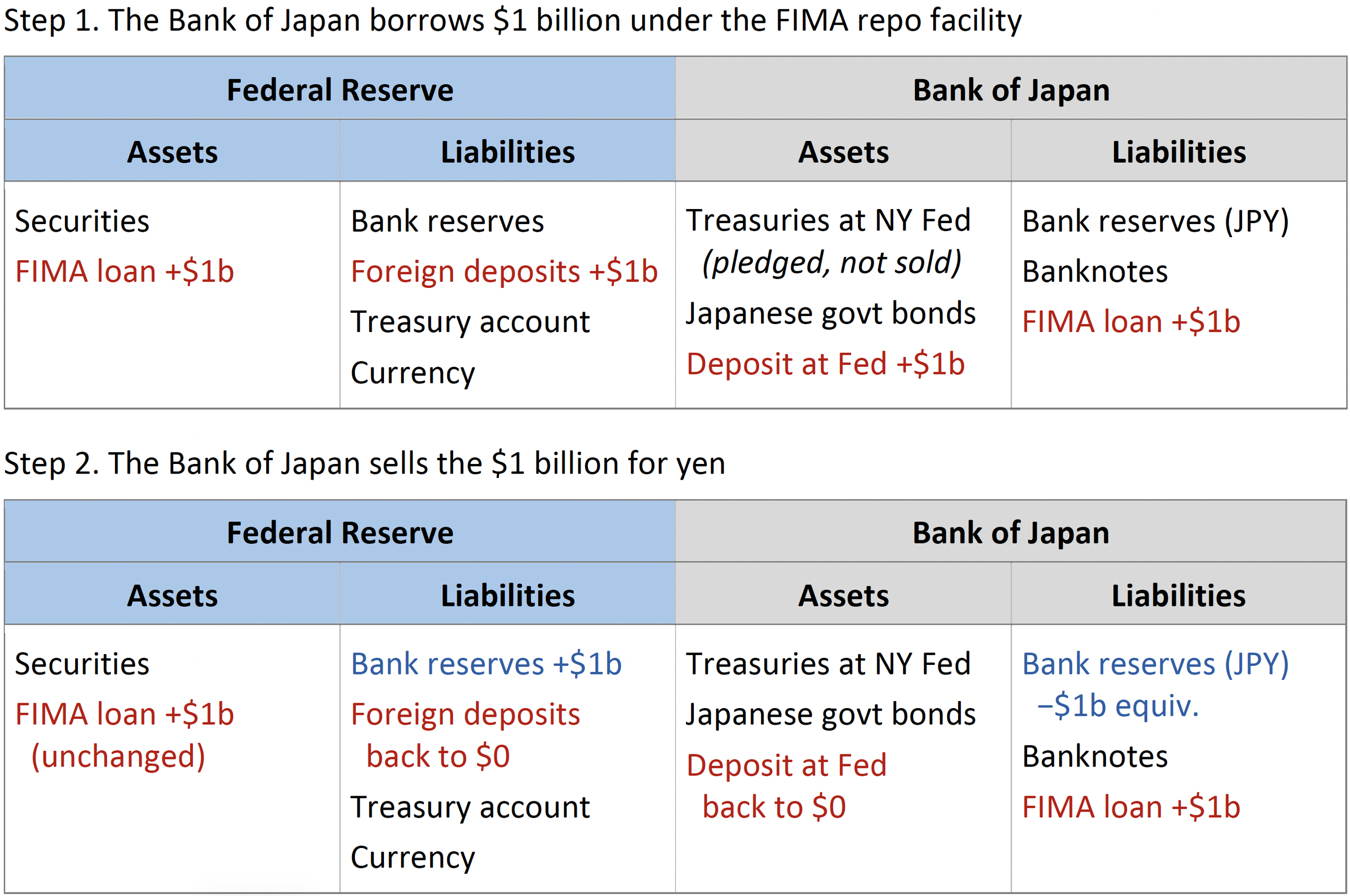
Notes. Entries in red change relative to the position before the drawdown. Entries in blue also represent changes; these have a matching entry on the balance sheets of global banks.
Who decides the size of the Fed's balance sheet?
In the example above, when the BoJ chose to draw on the FIMA facility, the Fed passively granted the loan. The Fed’s balance sheet stays larger until the Bank of Japan stops rolling the loan over. In other words, a foreign central bank, perhaps acting as agent for its finance ministry, is able to control the size of the Fed's balance sheet.
In this case, size matters: the FIMA cap limits that control. Raise it far enough and short-term control passes to any foreign central bank with a large custody account at the New York Fed. The $2.6 trillion of eligible collateral highlights the potential scale of the claim. To put that into perspective, note that the Fed's balance sheet currently totals roughly $6.8 trillion.
Monetary control involves more than the choice of the policy rate. It includes the choice of reserve regime. Reserves can be scarce, so that small changes in supply move overnight interest rates. They can be ample, so that the Fed sets rates administratively and supplies reserves in sufficient quantity to avoid scarcity. Or they can be abundant, so that the surplus flows into the Fed's overnight reverse repurchase (ON RRP) facility. The FOMC picks the regime it wants (currently, it operates an ample reserves regime). A large FIMA drawdown can shift the system from one regime to another with no decision by the Committee at all.
The Fed can respond in two ways. Both have costs.
First, it can sterilize (offset) the impact of the FIMA loan by selling Treasury securities. This drains the reserves that the loan created, preserving the balance sheet size and reserves regime that the Committee favors. But the required sale of Treasurys can prompt market participants to increase the compensation they require to hold these securities. The resulting upward pressure on yields is precisely what routing the operation through FIMA was meant to avoid. So, while the Fed can defend its own reserves regime, it can only do it by defeating the Treasury's purpose – a confidence-sapping conflict that would play out in public.
Second, the Fed can do nothing. In this case, reserves rise, and the system drifts from ample toward abundant. We saw how an abundant reserves regime functioned in the early 2020s, so we know what happens: the reserves that exceed the demand of banks and other eligible counterparties eventually find their way into the ON RRP facility. Reserves in the banking system end up near where they started, but the Fed's balance sheet does not. It is larger. A FIMA loan sits on the asset side and ON RRP balances sit on the liability side.
Moreover, because the foreign counterparty controls the rollover, the Fed cannot close the FIMA loan position. We have argued before that good reserve management depends on estimating the reserve demand quantities that mark the top and bottom of the ample regime. A FIMA drawdown makes that assessment harder.
The Treasury has its own options
It is important to understand that the Treasury has its own means to intervene in support of a foreign currency that would expand the Fed’s balance sheet. Treasury’s Exchange Stabilization Fund holds the U.S. allocation of Special Drawing Rights, the reserve asset the IMF creates and distributes to its members. Under the Special Drawing Rights Act of 1968, the Treasury can issue SDR certificates to the Federal Reserve banks against those holdings. The banks must purchase them, and the proceeds go into the Fund.
This route affects the Fed's balance sheet in the same way as a FIMA loan. It adds an asset and, once the Treasury spends the dollars, it increases bank reserves. However, Treasury has used this authority sparingly. For decades, both Republican and Democratic administrations have left most of the SDR capacity (currently more than $150 billion) idle, and no one has drawn on it to finance currency intervention. We read that nonpartisan choice at least in part as a sustained Treasury effort to preserve Fed monetary control and policy independence.
What is disclosed, and what is not?
There are three channels through which dollars can become available for intervention: FIMA; swap lines, where a central bank borrows directly from the Fed; and Treasury intervention. These vary dramatically in the degree of disclosure.
Swap lines are the most transparent. Since May 2010 the Fed has published drawings by each counterparty central bank. If the BoJ drew on its standing swap line – as it has done repeatedly since 2010 – the public would quickly learn both the amount and the borrower.
FIMA is the most opaque. The Fed publishes aggregate balances weekly without identifying the counterparties. The public learned the identity of a 2023 FIMA borrower from the foreign central bank itself, not the Fed.
Treasury intervention falls in between. The Treasury does not disclose its operations in real time. They appear in the New York Fed's quarterly report on foreign exchange operations, roughly six weeks after each quarter ends. This means that we should learn more about the July intervention by mid-October.
Both the U.S. and Japanese governments have promised greater transparency going forward. In their finance ministers' joint statement, they commit to public disclosure of intervention operations at least monthly. Yet, an intervention that a foreign central bank finances through FIMA appears nowhere in U.S. data releases.
The following figure suggests why the FIMA cap has attracted so little attention until now. Aggregate FIMA borrowing has been close to zero through nearly the whole history of the facility! The one exception is the March 2023 loan related to the Credit Suisse failure when loans reached $60.0 billion in the week ending March 22 and returned to zero five weeks later. The spike touches the red line marking the cap. A single borrower appears to have reached the limit in exactly the circumstance the FOMC built the facility to address.
FIMA loans (Wednesdays, billions of dollars), 2020 to August 2026
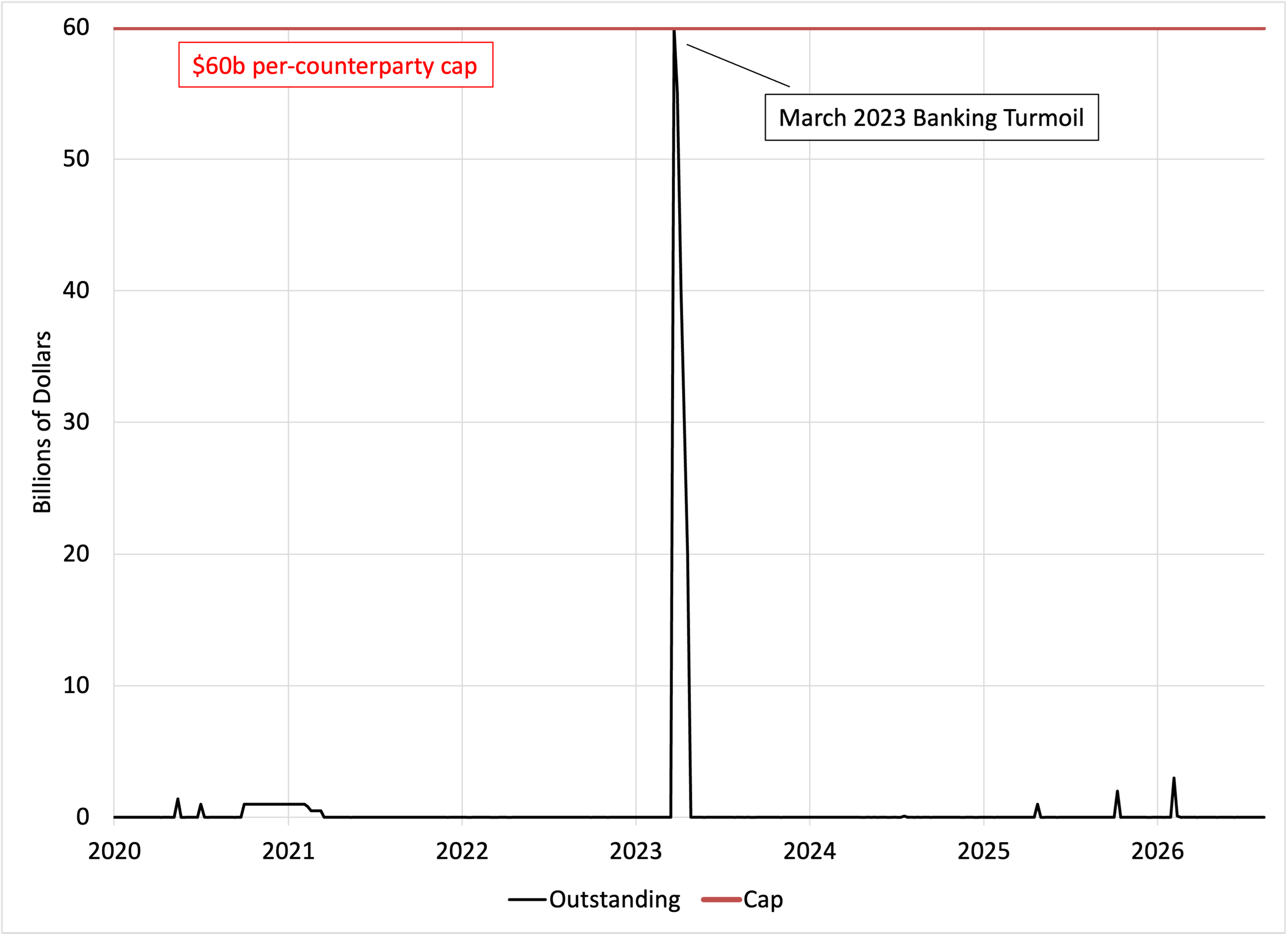
Notes. The red line is the $60 billion per-counterparty limit set when the FOMC made the facility standing in July 2021. The plotted series is the aggregate across all counterparties. Balances reached $60.0 billion in the week ending March 22, 2023 and returned to zero by the week ending April 26, 2023. Sources. Board of Governors, H.4.1; Federal Reserve Bank of St. Louis, FRED series H41RESPPALGTRFNWW.
The FOMC has drawn this line before
The potential threat to Federal Reserve monetary control from the Treasury’s foreign exchange authority is not new. Perhaps the most prominent example occurred in 1995, when Treasury asked the Fed to “warehouse” the Mexican debt it had bought through the Exchange Stabilization Fund (ESF).
Warehousing works like a swap between the two institutions. The Fed buys foreign currency from the ESF, pays dollars, and agrees to sell the currency back later at the same exchange rate. The ESF gets dollars that it has neither borrowed nor obtained by appropriation. To accommodate Treasury, the FOMC raised the warehousing limit from $5 billion to $20 billion. The opening citation from then-Richmond Fed President Broaddus highlights the reasons for his opposition: the confusion of monetary and fiscal policy and the threat to Fed independence. Fed Governor Lindsey and St. Louis Fed President Melzer dissented.
To be sure, Treasury never used the expanded warehousing authority. The limit reverted to $5 billion, and the Fed has warehoused nothing since 1992. Presumably, Treasury wanted capacity rather than cash. The episode eventually led Broaddus and Goodfriend to make the full case for separating the Fed from foreign exchange operations.
Conclusion
Chair Warsh has discussed where the monetary policy border lies. At his April confirmation hearing, Senator Warren asked whether the Fed could refuse a Treasury request to open a swap line. Without saying whether the Fed could refuse, he replied that Fed independence is at its peak in the operational conduct of monetary policy, and that officials get no special deference on questions of international finance. At a July hearing, Chair Warsh reportedly described the standing dollar-borrowing (swap) lines with central banks as part of monetary policy. Thus far, no one has asked him on which side of the line a FIMA drawdown for currency intervention falls.
In our view, the FIMA cap is doing what the Committee intended. FIMA offers support for foreign central banks when there are widespread dollar funding shortages abroad, while ensuring that the Fed maintains control of the size of its balance sheet.
If the Treasury wants to help defend the yen, it has its own, less opaque, tools. If the FOMC nevertheless chooses to raise the cap, it should state clearly when FIMA use is appropriate and publish enough detail, quickly enough, for the public to check that actual practice matches the stated purpose. That is the transparency we recommended to the Fed's five task forces.
The key question is not whether Japan obtains dollars to intervene over the coming months. It is whether the size of the Fed's balance sheet becomes something that governments favored by the Treasury can set. That would be a dangerous precedent.