
Rethinking the Fed's Inflation Framework
“The last task force, the one on inflation frameworks, that’ll examine the drivers of inflation, first principles, and weigh the full range of ideas for delivering price stability in a changing economy.” Chair Kevin Warsh, FOMC Press Conference, June 17, 2026
With those words, Federal Reserve Chair Kevin Warsh announced the broadest reconsideration of U.S. monetary policy since the FOMC adopted a formal 2 percent inflation target in 2012. Of the five task forces launched to rethink how the Fed operates, the Inflation Frameworks Task Force is to “revisit how the Federal Reserve understands and responds to the drivers of inflation.” This post focuses on how the FOMC responds. Identifying the drivers is largely a measurement problem that we address in later posts. (See our Roadmap to all the Task Force posts.)
The review is overdue. Five years of above-target inflation threaten to erode the credibility that the Fed spent several decades building. Drawing on nearly 70 years of Fed history and scholarship, we argue that the Inflation Frameworks Task Force should steer toward a cleaner, well-specified inflation-targeting strategy — and away from the vague strategies that allowed inflation to reach a 40-year record just a few years ago.
Why the Design of the Price Stability Framework Matters
The desire for price stability stretches back centuries, if not millennia. The reason is that stable prices allow people to plan far ahead, reducing the risks associated with long-term contracting and investment.
The modern academic debate about how a central bank can achieve price stability with a fiat currency reaches back to Milton Friedman (1968). He argued compellingly that monetary policy cannot permanently manipulate real variables: in the long run, the central bank determines only the price level.
Even a central bank that prefers low inflation feels the pull to inflate for a short-term boost to output — and, as Kydland and Prescott (1977) showed, rational agents anticipate exactly this, bidding up wages and prices in advance. The result is a systematic inflationary bias with no gain in output. Barro and Gordon (1983) and Rogoff (1985) worked out a solution: central bank commitment mechanisms that constrain discretion. Simple rules, like Friedman's (1960) original k-percent money growth rule and Taylor’s (1993) interest-rate rule, are examples.
Yet simply announcing a commitment to price stability is not the same as achieving it. Arthur Burns, who chaired the Fed through the Great Inflation, put it starkly a year after leaving office: central bankers “are inclined to lay great stress on price stability” and yet have “failed so utterly in this mission.” Professed commitment without a mechanism does not deliver.
A formal, public, quantitative inflation target supplies what those central bankers lacked: a disciplining mechanism. It gives markets, analysts, and the public a single observable number against which to assess the central bank’s performance — the transparency that Bernanke and Mishkin (1997) stressed. By the mid-1990s, investors viewed the Fed as following a de facto 2 percent inflation target. When the FOMC formally announced a 2 percent personal consumption expenditures (PCE) inflation target in 2012, inflation expectations were already anchored — at least according to financial markets. (Note that the consumer price index rises slightly faster over time than the PCE index, so market inflation expectation readings are broadly consistent with the Fed’s 2 percent PCE inflation target.)
Three Frameworks, One Problem
With commitment to a numerical target as the starting point, the key framework design question is: should the central bank target the inflation rate period by period, the price level along a pre-announced path, or nominal GDP?
Under standard inflation targeting (IT), bygones are bygones. In contrast, under price-level targeting (PLT), policymakers commit to make up any shortfall or overshoot, keeping the price level on a steady (upward) path. That commitment has a surprising payoff. Svensson (1999) showed it can buy a "free lunch": in addition to removing the inflation bias, PLT can mean less inflation variability. The payoff grows at the zero lower bound (ZLB). There, as Eggertsson and Woodford (2003) showed, a credible promise of later (temporary) above-target inflation lowers the expected real interest rate today — so PLT's history-dependence delivers stimulus just when the central bank has run out of room to cut.
The third framework, nominal GDP (NGDP) level targeting, has a different selling point: it accommodates supply shocks automatically. When a negative supply shock cuts real output, the central bank lets the price level rise to keep nominal spending on track, avoiding a deflationary squeeze. Long championed by Sumner and endorsed by Woodford (2012), it has a certain robustness: as Hall and Mankiw (1994) argued, NGDP targeting does not require disentangling price and quantity movements in real time.
In our June 2014 post, we compared all three frameworks empirically. Restoring the price level to its pre-crisis 2.1 percent trend might have been manageable. But it was implausible to think nominal GDP could return to its pre-crisis trend, which would have demanded roughly 10 percent nominal growth for three years.
PLT remains theoretically attractive, and its ZLB advantages seem important. But the theory takes two things for granted. The first is credibility: unless the public believes the “makeup” promise, it will not stabilize inflation. Unfortunately, the FOMC’s 2020 experiment with flexible average inflation targeting (FAIT) suggests that the environment for sustaining such promises is weaker than theorists assumed. The second is a price level worth targeting — one measured cleanly enough to anchor a decades-long path.
The Empirical Record
This brings us to the data.
The chart below tells the story of U.S. prices over the past 30-plus years, the period of de facto or de jure inflation targeting. It shows the path of the PCE price level since January 1995. From 1995 through 2007, PCE prices tracked the 2 percent path with remarkable fidelity: deviations reversed rather than accumulating. Bernanke and Mishkin (1997) described this as implicit inflation targeting under Greenspan; we called it de facto PLT in our August 2020 post.
U.S. Personal Consumption Expenditures Price Index (monthly, Jan 1995=100) versus a cumulated 2 percent annual trend, 1995 — May 2026.
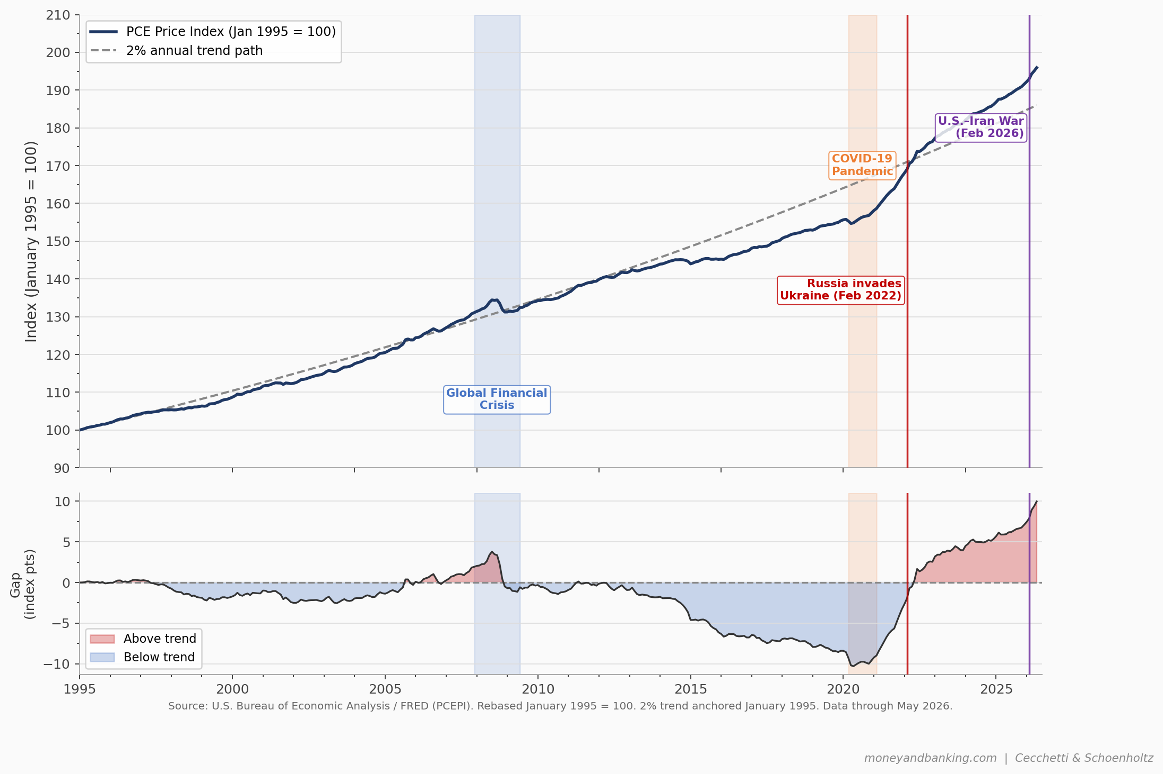
Notes. Top panel: PCEPI (blue line) and long-run 2 percent path (dashed line). Shaded bars mark the Global Financial Crisis (Dec 2007—Jun 2009) and the COVID-19 pandemic (Mar 2020—Feb 2021); vertical lines mark Russia’s invasion of Ukraine (Feb 2022, red) and the onset of the U.S.—Iran conflict (Feb 2026, purple). Bottom panel: the gap between the actual price level and the 2 percent trend; blue fill marks below-trend periods, red above. Sources. FRED and authors’ calculations.
The Global Financial Crisis broke that pattern, opening a persistent below-trend gap (bottom panel) that widened for more than a decade. By the pandemic’s eve, the price level sat roughly 4 percent below the 2 percent trend. Persistent low inflation, combined with worries about a declining neutral interest rate, left policymakers fearing that there would be little room to ease before hitting the ZLB. A credible makeup framework, as we argued in our December 2017 post, could provide meaningful insurance against a return to the lower bound. That reasoning motivated the FOMC's ill-fated FAIT framework of 2020.
What followed more than reversed the prior undershoot. The 2021—2023 inflation surge pushed the price level above the 2 percent trend. Russia's invasion of Ukraine in February 2022 added an energy shock that pushed it higher. Then, in February 2026, the U.S.—Iran conflict brought a fresh energy price surge. By May 2026, the PCE price level sat 5.4 percent above the 2 percent trend — the largest positive gap in this 30-year window.
The Experiment with FAIT
Was the Fed’s 2020 FAIT framework a sensible response to a decade of below-target inflation and a declining neutral rate? In our September 2020 post, we explained that “average inflation” targeting is a hybrid of IT and PLT: the longer the averaging window, the closer it comes to price-level targeting. In practice, however, two design flaws and one implementation choice doomed FAIT.
First, the FOMC never specified the averaging window or restoration period. Without those, markets and households could not tell what the framework promised. Inflation expectations remained anchored, but on the earlier record — not on anything that FAIT provided. Second, the FOMC introduced an unwarranted asymmetry: the makeup provision applied to shortfalls but not to overshoots. Policymakers would compensate when inflation ran too low, but not when it ran too high. By design, inflation would drift up — a long-run bias dressed up as a stabilization framework. Third, the FOMC failed in its implementation. Policymakers bet on forecasts that the 2021 surge would prove transitory, rather than reacting as the price level pulled away from any plausible trend (see our October 2022 post).
As we warned at the time, the FOMC was “facing a crisis of its own making,” with its credibility for price stability “at serious risk” (see our February 2022 post). The subsequent 525-basis-point tightening cycle, the years of above-target inflation, and the still-elevated price level in the chart all bore out the warning.
Warsh’s characterization at his June 17 press conference was unflinching: inflation “has been running well ahead of the Fed’s long-stated inflation goal of 2 percent… for more than five years.” Asked whether the 2 percent target is under review, he was equally clear: “I see no reason until we have reestablished our commitment and ability to deliver on the 2 percent inflation objective to revisit that. So that’ll be outside the scope of what we’re taking on.” We find that exclusion fully justified: the FOMC must re-earn credibility before considering the target itself. But that only defers the bigger question. Once the Committee has reestablished credibility, and inflation is back to 2 percent, which framework should the FOMC adopt?
One complication cuts across all monetary policy frameworks: a target is only as good as the index behind it. Policymakers ultimately care about stabilizing the true cost of living — something no real-world price index measures perfectly. Known biases — in medical care, housing, and fast-changing digital goods — mean a measured 2 percent increase need not correspond to a 2 percent rise in living costs. The choice of the index itself matters as well: the CPI and the PCE indexes differ in coverage and weighting, so they typically diverge by about 0.35 percentage points a year. These measurement questions bear on both the number and the price gauge the FOMC should target.
What the Inflation Frameworks Task Force Should Do
Warsh is right to return to first principles. “Inflation is a choice,” he reaffirmed on June 17. The Task Force’s job is to build a framework that makes the right choice durable, credible, and clearly understood.
The theoretical record and 30 years of data point to three elements of sound framework design, even after the FOMC achieves its current 2 percent target.
Retain the 2 percent PCE inflation target. Blanchard, Dell’Ariccia, and Mauro (2010) and Ball (2014) argued for a higher target on ZLB grounds, but five years of above-2 percent inflation have changed the calculus. The risks of upward drift in the target and lost anchoring are now greater than the risk of insufficient headroom at the lower bound. And if artificial intelligence raises trend productivity growth, the neutral rate rises with it, leaving more headroom than the pre-pandemic debate assumed. We return to the impact of AI on key Fed benchmarks in a later post.
Make the reaction function explicit. Without an explicit reaction function, a framework cannot be credible. We made that case in our June 2026 post on FOMC communications. Beyond the central case that appears in the SEP, the FOMC should include scenario analysis showing how policy would respond to supply shocks. If the FOMC communicates clearly, observers will understand contingent projections, adding to credibility without sacrificing flexibility.
Apply makeup strategies only in exceptional circumstances, ensuring they are symmetric and explicit. The ZLB case for history-dependence has not disappeared. But any averaging window and restoration period must be public, and the makeup strategy must apply to overshoots and undershoots alike. Vague, asymmetric average inflation targeting failed, imposing real costs on households and businesses.
Two cautions temper our recommendations.
The first is that no central bank has run a specified makeup framework, so we cannot know whether any such rule — however well designed — will condition private expectations the way theory promises. Bernanke's (2017) conditional PLT, which switches from inflation targeting to price-level targeting only at the ZLB, remains a potential candidate — but it is untested too, so the Task Force would need a reliable way to assess it before recommending adoption. While surveys and experiments on household and forecaster behavior may help, the evidence will almost surely remain thin.
The second caution is about measurement. A price-level targeting commitment relies on the quality of the index behind it, and better treatment of digital goods, health care, and housing would sharpen how the Fed reads deviations from trend. The bias in a price index is not a fixed wedge. It swells when relative prices scramble, which is exactly what a broad supply shock does. So the gap between measured and true inflation widens at the moment policy most needs a clean reading. A framework that stakes policy on a decades-long price path inherits every one of those errors. Because this subject is as much the Data Task Force’s charge as the Inflation Frameworks Task Force’s, we take this up in another post.
For now, the pragmatic conclusion is a modest one. Until there is compelling empirical evidence on makeup strategies, and until price measurement improves, a clean, well-specified inflation target — one that does not stake policy on a decades-long price path — may be as far as today's science of monetary policy can take us.